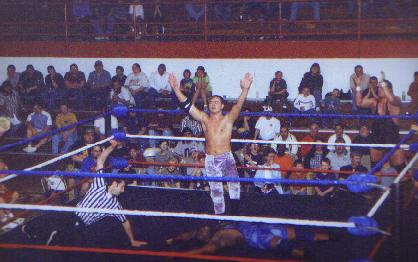
SIDE NOTE: Last week, I talked about creating a memorable character and neglected to mention somebody most of you know who has done that as well as anybody on the independent level. When I attended my first World Legion Wrestling event in 1999, I took note of one guy who stood out above all others as a star. It was “Atomic Dogg” Steve Sharp, who was big, charismatic, and found away to set himself apart from the pack. He must have made a killing that night in merchandise sales: you’d have thought “Stone Cold” Steve Austin was selling T-shirts and photos. I’ve seen him at a half-dozen or more shows and I have yet to see him come across as anything but a legit superstar. Of course, there have always been heels like Derek Stone working hard for him in the ring, and they deserve a great deal of credit as well, but Steve Sharp should be observed and imitated when it comes to character development and self-marketing.
Chapter 5: Professionalism
Conducting oneself in a professional manner when representing the wrestling industry is not optional. Rarely is professionalism praised; on the other hand, unprofessional behavior can screw up a career.
One of the first things I tell beginners is to stay humble. Always. Pro wrestling isn’t like football, where arrogance is apparently a prerequisite for success at collegiate and pro levels. In wrestling, it’s viewed as a lack of respect for the business and for your colleagues and predecessors.
At a show in 2007, a guy who is a regular performer with a large independent promotion was on a smaller independent’s card. He was unfriendly and unapproachable, like he was better than the other guys, failing to extend the most fundamental courtesies like introducing himself to them. Though he is a good worker and he had a good match, his detriment to the morale of the company’s regulars was greater than the benefit of having him in their ring. If I ran a promotion, I wouldn’t consider booking him and I’d spread the word.
When traveling to an event, carpool when possible. Although you are not being paid to be at the event while you are a student, you still need to be prepared to pitch in for gas. I never let students pay because it didn’t feel right since they weren’t on the payroll (and because I rarely drove), but be prepared to pony up your share. The best way to split gas costs fairly is for the driver to begin the trip on a full tank. At the end of the trip (and when necessary during the trip), the driver fills his tank. The cost of fuel is split between all parties in the vehicle. He ends with the gas gauge where it began, so he’s not getting screwed. A little trick I learned from T.S. Aggressor and Mr. Destiny.
On a somewhat-related note, get separate checks at restaurants. People tend to forget about their beverage, shared appetizers, sales tax, and gratuity (wrestlers, for that matter, are notoriously terrible tippers) when tossing in their portion of the meal ticket and the guy walking up to the register gets stuck with the difference.
Be a light traveler. Bring two sets of gear if you have them, but aside from that take only what you need, like hygiene products, merchandise, and an extra change of clothes. Once upon a time, I was one of six wrestlers traveling in a minivan and we were already cramped when we picked up the last person. He brought one full-sized suitcase, one smaller one, a duffel bag, a cooler and, unbeknownst to the driver when arrangements were made, his kid. That’s very poor manners, as is it when all passengers sleep in a car while the driver fights to stay awake.
When you get to the venue (the building in which the event is held), greet everybody and offer a handshake. Introduce yourself to any strangers: you know the routine. Students, find out how you can make yourself useful and, while you should watch the event and learn what you can from it, your primary role is to accomplish the tasks to which you are assigned.
Wrestling is a business and, like every other business, it’s about turning a profit. Don’t be that guy who asks for a dozen complimentary tickets for your girlfriend, parents, and every obscure relative you can think to invite. It’s usually okay to bring your significant other along once you’ve started wrestling, but otherwise any guests should buy a ticket.
Obviously, professionalism also applies when you become a wrestler. The correct term for wrestling against somebody is “working with” somebody. That means you and your opponent work together to have a good match. When discussing your match, let the veteran lead and then when he invites you to add ideas, don’t be shy about giving your input. If he doesn’t like your idea, there may be a good reason for it, so don’t pout if it gets shot down. As you gain experience, putting matches together becomes more of a compromise.
During a match or during training, it’s common to get hit, or to hit somebody, with a stiff shot. If it happens to you, stiff the person back and that should be the end of it. If you stiff somebody, expect it in return; it’s nothing personal. There is rarely an excuse for a wrestler to come back to the locker room upset at the guy he worked with. When somebody would bring up a stiff shot that I gave him, I was not usually very happy about it. “That happened five minutes into a twelve-minute match,” I’d say. “You had seven minutes to give me a receipt, so why are we talking about it now?” Mistakes happen during a match, and I never freaked out about them because I felt I was a solid worker capable of covering up most blunders. The only time I would be unhappy about it is if my opponent showed no regard for my safety or if he didn’t listen well while I was leading.
Once in a blue moon, you may end up in a match with somebody who is unprofessional, clueless, or who simply wants to start a fight in the ring: you may be involved in a shoot (real fight) at some point in your career. If you can handle the situation and keep the match together, do so. If you’re overmatched, do what you must to protect yourself. Should a promoter fault you for taking defensive measures, find work elsewhere. As a wrestler (student or otherwise), you never relinquish the reasonable expectation to have your personal well-being protected by all others you work with, or to defend yourself when that expectation is not met.
When in the ring, don’t humiliate your opponent. A slap is acceptable if used properly, but be respectful and use common sense. Don’t make your opponent look like a bitch, pull his trunks down, etc. If you’re stupid enough to do that and you get punched in the mouth, you don’t get to give a receipt. You stiffed your opponent first by disrespecting him.
After the match, thank your opponent and shake his hand, then ask if everything was okay. He should do the same. This is not the time to nit-pick, so the only time you should say much (especially until you have some experience) is if it is something major, like a person blowing up (losing his wind) during your comeback or being reckless in the ring. If there was a miscommunication in the ring, however, it is permissible to seek a clarification at this time.
While at the venue, be respectful at all times to everybody. The weird-looking lady with a mullet sitting at the foot of the bleachers while the ring is being set up just might be the nice woman who decides if the promotion gets to come back to the building. The boy with Down’s Syndrome you’re mocking just might be her son. You can still be a heel and get heat without using poor taste. Besides, crossing the line of poor taste doesn’t sell tickets; in fact, it can and will have the opposite effect.
Keep your conversation clean. Give your phone number to anybody who might want to hear about the fat girl you hooked up with two nights ago and tell the story at a more appropriate time. Word-of-mouth is a powerful advertising tool that can help or hurt the business. If you stop at Subway before an event and act like a jerk to the guy in line behind you, he’ll tell a friend about the wrestler coming into his town and treating him badly. That friend will tell three friends who were thinking about buying tickets, and they might decide against taking their kids to see foul-mouthed jerks who come into their town and bully their friends and neighbors.
Wrestlers typically get paid cash in an envelope. When a wrestler is counting his money, leave him alone. Never ask what another person gets paid: it’s none of your business and you might not want to know who’s making what.
I know this chapter bounces around a lot, but here are a few other courtesies you should extend:
1. When a name (a famous wrestler booked to draw a crowd) is brought it for an event, don’t badger him. He might watch the matches as much as he can and give pointers to the wrestlers, but that’s up to him. Don’t fish for compliments: he doesn’t want to answer questions like, How did my suicide dive look?
2. While you are a student, understand that no matter how much you think you know about the business, you shouldn’t openly critique matches. Watch them and form your own opinions, but keep them to yourself. I personally liked getting feedback and fielding questions from students about my work because I liked knowing they were paying attention, I wanted them to learn, and it made me practice what I preached; however, not all wrestlers would agree.
3. If you are wrestling and you’ve brought your own t-shirts, photos, etc., ask the promoter if you may sell them. Some promoters ask for a percentage of your merchandise sales. If you don’t like his terms, don’t sell your merchandise. Learn from it and make sure that you and the promoter agree on the terms before you take another booking with him. Some promoters also won’t let you sell anything besides photos. It’s a business, and he may want fans to buy his promotion’s T-shirts, not yours. Bring your own change and expect to provide your own salesperson if you need somebody other than yourself to take money, make change, etc. Price your pictures the same as the other wrestlers’ photos. Don’t be that guy who undercuts everybody else.
4. Never, EVER, bring merchandise of anything or anybody other than yourself. The promoter and other wrestlers often depend upon their own merchandise sales to make money, and if you are selling John Cena action figures, fans will buy them and you’ll look bush-league as hell. If for any reason you feel you need to sell wrestling merchandise other than your own, open an eBay store and do it there.
5. This should fall under the Common Sense category, but I’ve seen the wrestler who discourages fans from buying one wrestler’s pictures in effort to sell his own. Even if he volunteered all of his free time to Habitat for Humanity, he’s still a dick in this book.
6. Hygiene is also a form of professionalism. Every time a wrestler steps into the ring, his gear should be clean. That includes kneepads, and by washing, I don’t mean spraying Febreeze on things in lieu of laundering them. It’s funny how most wrestlers are full of ego–no disrespect: I was, too, and maybe I still am–yet many are so starved of self-respect that they step into the ring smelling like a jock strap. A little trick I learned is to use liquid fabric softener when washing gear. If you don’t have a washer and dryer and can’t make it to the laundromat, use the sink. Fill it with water, dump a little detergent in it, and scrub your gear. A quick way to dry a piece of clothing is to roll it up in a towel, wring it out, step on the towel several times, and drape the nearly-dry gear over something like a shower curtain rod.
7. Also falling in the category of professionalism and hygiene is shaving. As a man, it’s humbling the first time you take a razor to your legs, but the first time you get a hairy, sweaty leg in your mouth during a headscissors, you’ll understand. I was taught that a wrestler’s forearms, armpits, and legs should be shaved. A little pointer for first-time shavers: use an electric razor with its lowest attachment the first time and follow it with manual shaving, this is how to prevent ingrown hairs.
Hygiene may seem petty, but I’ve had matches with some smelly guys, and it’s hard to work a good match when your stomach is turning. It also makes a wrestler seem less special to the fans when they approach him for an autograph and he smells like dirty butt and body odor. Additionally, good hygiene can help prevent common ailments like ringworm and staph infection.
Professionalism is something that everybody should always maintain. If I’m promoting, I would book a lesser-talented or more-expensive wrestler over one who is superior in the ring or cheaper but unprofessional.
Naming “Names”
You can tell the difference between somebody who respects this business and somebody who is in it for the wrong reasons by the way he conducts himself. A lot of wrestlers have had a small taste of notoriety and think they’re stars immune to extending the most basic courtesies to those “below” them, but you need look no farther than a guy like The Honky Tonk Man to be able to tell the difference between somebody who was a legitimate star and somebody who is a star only in his own eyes.
The Honky Tonk Man was one of the top heels in WWE for several years and has stayed active, doing independent shows for the better part of the last decade or so. Every time I’ve met him, he has walked into the locker room and greeted everybody, from the promotion’s top guys to the students. He doesn’t have to act like a star; he is one. On the other hand, I’ve met guys who had short runs in also-ran promotions who act like the business wouldn’t exist if not for them. They act like stars because they’ve never been stars.
When a “name” wrestler comes in to do a show, he has a responsibility to the business, the promotion, and the wrestlers to make himself as worthwhile as possible. He’s probably making more money than every other person on payroll combined and, if he wrestles, he will probably not break much of a sweat in doing so. He deserves his payday because people buy tickets to see him, but a promoter should get his money’s worth out of the wrestler. A promoter will pay $1,000 or more between booking fee, flight, hotel, and rental car to bring in an average name. Ignoring variables like taxes and venue split, it appears that in order to break even when paying $1,000 to bring in a name, a promoter must see 100 fans (who would not have attended without the name on the card) buy a $10 ticket. If done correctly, bringing in a name is long-term investment that’ll pay off long after the gate receipts from that event are counted.
Before booking the name, the promoter should ask–the name won’t likely offer–if the name will watch the matches on the card and critique them to the wrestlers afterwards. Then the promoter should have a notebook and a couple of pencils ready for the name to take notes on each match. The improvement the promoter should see in his regular crew from the advice given by guys who have been stars in the business will make the investment pay off in the long run.
NEXT WEEK: CHAPTER 6: PROTECTING THE BUSINESS















 Missouri Wrestling Revival